












Vienna Phases Out Coal and Gas: Moving Towards Clean Energy
30.9.2026
Vienna is transforming the way it produces and consumes energy. The city is looking for smarter and more efficient ways to use energy and is focusing on renewable sources. Its key areas of focus include photovoltaics, the electrification of public transport, heat pumps, green hydrogen, district heating, and the direct involvement of residents in the clean energy transition.
Vienna’s Goals by 2040
- climate-neutral city
- climate-neutral buildings
- end of fossil heating
- renewables as the basis of the energy system
Breaking Away from Gas, Letting the Sun Take Over
Vienna has set an ambitious goal: to end the use of fossil energy sources by 2040. These are to be replaced by carbon-free heating and cooling systems. This is a major challenge – around 600,000 households still rely on fossil fuels today, accounting for up to 90% of emissions from buildings. The city is therefore accelerating the transformation of its building stock through the “Phasing Out Gas” programme.
This initiative includes 100 Projects designed to demonstrate that renewable heating is possible even in buildings where district heating cannot be used. This mainly concerns multi-storey residential buildings. The city has already succeeded in converting around 1,800 flats to fossil-free heating, replacing 1,000 gas boilers, and installing 70 photovoltaic systems. Starting in 2026, the programme also expands to schools, offices, and other non-residential buildings.
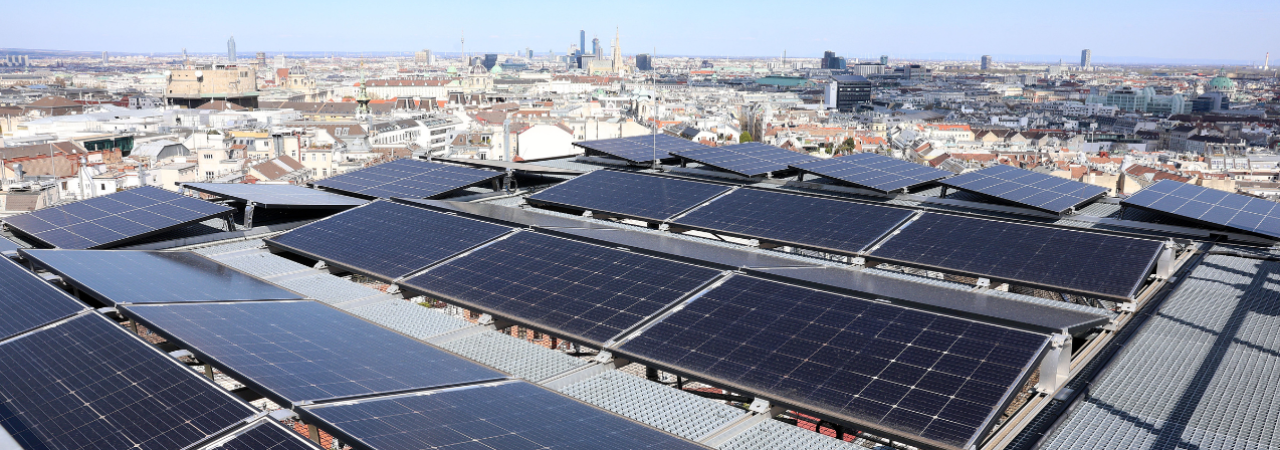
Where else is Vienna’s energy transformation making great progress? In solar power! It has become one of the pillars of the city’s energy system. The municipal energy provider Wien Energie now operates more than 500 photovoltaic plants and is the largest regional producer of solar energy in Austria. Since 2021, Vienna’s photovoltaic capacity has experienced rapid growth. The city launched a “solar power offensive” and is now reaping the benefits. Installed capacity has increased from 50 MWp to almost 330 MWp – more than a sixfold rise. By 2030, the city aims to reach 800 MWp.
Solar electricity currently powers more than 92,600 households in Vienna. This success is the result of a combination of targeted investments, simplified permitting processes, and financial subsidies. The solar boom is making a tangible contribution to climate protection. By the end of 2025, the city had around 17,600 photovoltaic installations in its network, which together save approximately 73,700 tons of CO₂ annually – comparable to the carbon footprint of a city of about 8,500 people.
In Vienna, solar panels can even be found in unexpected places. They are often installed on protected historic buildings, such as the roofs of the Vienna City Hall, the Vienna State Opera, and the Ernst Happel Stadium. They are also present at the Vienna Central Cemetery or on large fields in the Donaustadt district, where electricity production goes hand in hand with sheep grazing.